Attention is Everything: What Agents Learn from Human Focus
Agents struggle with attention the same way humans do. The strategies that help you focus—lists, references, memory tiers—are the same ones that keep agents on task.
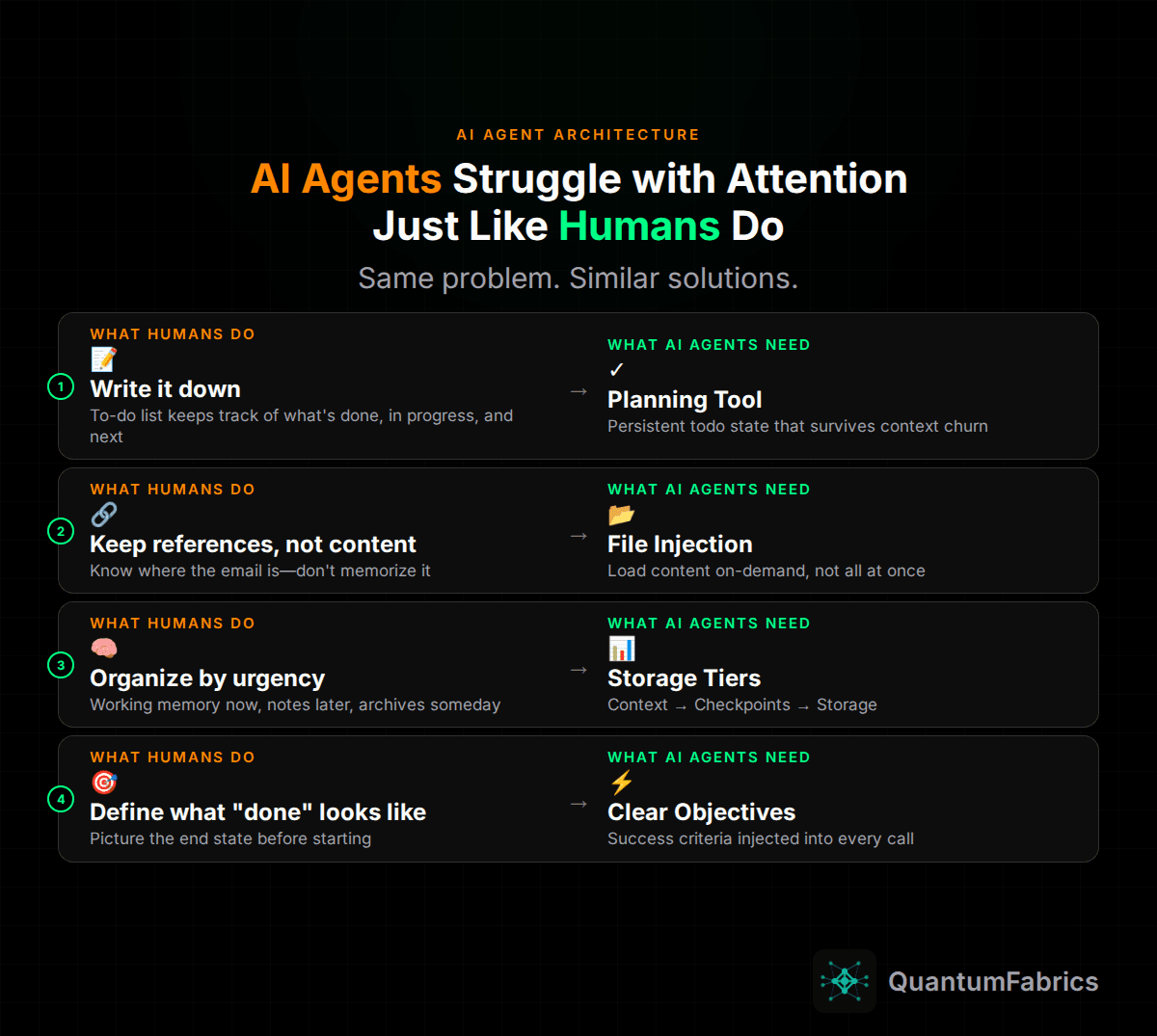
Attention is Everything: What Agents Learn from Human Focus
Agents struggle with attention the same way humans do.
This shouldn't be surprising. We built them.
What Humans Do to Stay Focused
When you face a complex task—the kind that takes hours or days, involves multiple steps, requires remembering details while making progress—you don't try to hold everything in your head. You've learned strategies.
1. You Write It Down
A to-do list. A checklist. A plan scratched on paper.
The act of writing externalizes the task. You can see what's done, what's in progress, what's next. When you get distracted or interrupted, the list brings you back. It's an anchor.
Without it, you rely on memory. And memory drifts. You forget step 4, repeat step 2, convince yourself step 6 is done when it isn't.
2. You Keep References, Not Content
You don't memorize the entire email. You don't hold the whole document in your head.
Instead, you remember where things are. "The pricing details are in that spreadsheet." "The client requirements are in their last message." You know you can re-read it if you need the details. That knowledge lets you proceed with the big picture without drowning in specifics.
This is the difference between memorizing a phone number and knowing it's in your contacts. The outcome is the same—you can make the call—but the cognitive load is different.
3. You Organize by Urgency
Not all information deserves equal mental real estate.
Working memory is precious and limited. You keep active thoughts there—what you're doing right now, the immediate next step, the current problem.
Notes and documents hold what you'll need soon but don't need to keep front-of-mind. Meeting notes. Reference materials. Details you've processed but want to preserve.
Archives hold the rest. Old projects. Background research. Things you might need someday but definitely don't need now.
This tiered approach keeps your working mind clear. You're not trying to remember everything. You're trying to remember what matters right now.
4. You Define What "Done" Looks Like
Before diving in, you picture the end state.
"When this is done, I'll have a working prototype." "Success means the report is submitted and the client is happy." "I'm finished when all three tests pass."
That definition stays visible—maybe literally visible, pinned above your desk or written at the top of your notes. When details overwhelm, you glance at it and recenter.
Without it, scope creeps. Work expands. You're not sure if you're making progress or spinning.
Agents Need the Same Strategies
Context windows are large. 128K tokens. 200K tokens. Even larger coming.
But size isn't the constraint. Attention quality is.
As context fills with tool outputs, intermediate calculations, and conversation history, agents drift:
- Objective drift: Forgetting the original goal
- Redundant work: Repeating completed steps
- Hallucinated completions: Claiming done what isn't done
- Latency: Processing bloated context slows everything
Sound familiar? It's the same failure modes humans experience when overloaded.
The fix isn't a larger context window—just as the fix for human overwhelm isn't a bigger brain. It's architecture that mirrors how humans manage attention.
Four Strategies That Work for Both
Strategy 1: Write It Down → Planning Tools
Agents need a to-do list.
A planning tool that the agent updates throughout execution:
write_todos([
  { content: "Extract documents", status: "completed" },
  { content: "Analyze candidates", status: "completed" },
  { content: "Generate report", status: "in_progress" },
  { content: "Send notifications", status: "pending" }
])
This creates an objective anchor. No matter how cluttered the context becomes, the agent can always see what's done, what's in progress, what's next.
Just like your to-do list after an interruption—glance at it, recenter, continue.
Strategy 2: Keep References, Not Content → File Injection
Agents don't need to hold entire files in context.
Instead, inject file content on demand. The agent knows files exist. It loads them when needed. The rest of the time, it operates on summaries, references, and high-level knowledge.
This is how you treat that long email thread. You know the details are there. You can pull them up if needed. But you're not carrying them in active memory while doing other work.
// Instead of loading everything at start:
context = loadAllFiles() // ❌ Bloats context

// Load on demand:
function loadFileWhenNeeded(path) {
  return readFile(path) // ✓ Fresh context per reference
}
Strategy 3: Organize by Urgency → Storage Tiers
Not all data belongs in context.
A storage pyramid routes information to the right tier:
       ┌─────────────────┐
       │    Context      │  ← Working memory (ephemeral, fast)
       │   (active)      │
       ├─────────────────┤
       │  Checkpoints    │  ← Notes (persistent, recoverable)
       │    / NFS        │
       ├─────────────────┤
       │  Blob Storage   │  ← Archives (durable, slower)
       │   / Database    │
       └─────────────────┘
Active work stays in context. Completed task details checkpoint to persistent storage. Artifacts and outputs archive to blob storage.
The agent isn't trying to remember everything. It's keeping context clear for what matters right now.
Strategy 4: Define "Done" → Clear Objectives
Every agent execution should start with success criteria.
What does "done" look like? What are we trying to accomplish? What should the output be?
This objective stays prominent—injected into each model call, visible even when context is truncated. The agent can always recenter on the goal.
Without it, scope creeps. The agent explores tangents. It's not sure if it's making progress or spinning.
Implementation: Think Human-First
When building agent architecture, ask yourself: "What would a human do?"
Human behavior: Makes a checklist before a complex task Agent architecture: Planning tool with persistent todo state
Human behavior: Knows where files are without memorizing contents Agent architecture: File references with on-demand injection
Human behavior: Keeps working memory clear by offloading to notes Agent architecture: Storage tiers with appropriate persistence
Human behavior: Writes the goal on a sticky note Agent architecture: Objective injection in every model call
The parallel isn't perfect—agents and humans differ in important ways. But the core challenge is the same: finite attention, unlimited input, the need to focus.
Measuring the Impact
| Symptom | Without Strategies | With Strategies |
|---|---|---|
| Objective drift | Common after turn 10+ | Rare |
| Redundant work | 15-30% of operations | < 5% |
| Task completion accuracy | 85-90% | > 98% |
| Recovery from interruption | Full restart | Resume from checkpoint |
These aren't optimizations. They're the architecture for agents that maintain focus through complex, long-running tasks.
Conclusion
Agents struggle with attention the same way humans do.
The strategies that help you focus:
- Write it down
- Keep references, not content
- Organize by urgency
- Define what "done" looks like
Are the same strategies that keep agents on task:
- Planning tools
- File injection
- Storage tiers
- Clear objectives
When building agents, think human-first.
The same attention strategies you use are the ones your agent needs.
Sources: